
Scientific Conferences
At Andes, our approach to Carbon Dioxide Removal (CDR) is grounded in rigorous scientific research and data. We regularly present our findings to the scientific community at leading global conferences. Below, you'll find a selection of our recent presentations that detail the mechanisms, modeling, and field validation of our microbial weathering technology.
Microbially Accelerated Weathering: Leveraging Biology to Enhance Weathering in Alkaline Soils
4th Enhanced Rock Weathering Conference (ERW'26)
Guelph, Ontario, Canada · July 2026 · Oral presentation (O7)
Andes presented Microbially Accelerated Weathering (MAW), a biologically driven pathway to carbon dioxide removal that is mechanistically distinct from conventional Enhanced Rock Weathering. Rather than transporting crushed silicate rock into acidic soils, Andes applies, through a seed treatment, root-associated Bacillus sp. strains that accelerate the weathering of silicate minerals already present in alkaline agricultural soils. Because the approach measures soil inorganic carbon directly as its basis for MRV, it offers a conservative and cost-effective way to quantify removal. The talk brought together evidence spanning laboratory studies, soil mesocosms, reactive transport modeling, and commercial field deployment.
Key Findings:
MAW is a distinct CDR pathway: Andes’ microbes grow with plant roots and accelerate weathering of pre-existing cation-bearing silicates in alkaline soils, with soil inorganic carbon (calcium carbonate equivalent) providing a direct, conservative basis for MRV rather than cation-proxy or feedstock mass-balance models.
In vitro studies reveal microbial control of soil pH: the microbes modulate the silicate microenvironment pH, releasing calcium and magnesium through silicate dissolution, and later favoring carbonate formation, with biofilms forming directly on cation-bearing silicates (Timmermann et al. 2025, Global Change Biology).
Mesocosm experiments confirm weathering and carbonate formation: Strain MP1 increased base cations and soil inorganic carbon over 60–90 day experiments, sequential extractions trace the cations from silicate dissolution, and metagenomic/qPCR analyses confirm the microbes persist through the experiments (Lawrence et al., preprint on CDRXIV; Yang et al. 2026, Global Change Biology).
Reactive transport modeling constrains the system: anorthite weathering increases roughly sevenfold, soil inorganic carbon accumulation represents ~40% CDR efficiency relative to total silicate dissolution, and secondary mineral formation (calcite, kaolinite) are central to sustaining weathering (Lawrence et al. 2026, in prep.).
Commercial field deployment supports scalability: across more than 300 fields in the 2023–2024 US seasons, alkaline soils (those with an initial pH above 7.0) showed significantly greater soil inorganic carbon accumulation in MP1-treated soils, with no shifts in pH or base saturation.
Microbially Accelerated Weathering for CDR: Reactive Transport Modeling to Quantify Rates and Sinks
EGU General Assembly 2026 (EGU26)
Vienna, Austria · 3–8 May 2026 — Session SSS5.4 — Carbon sequestration in soils · Abstract EGU26-13829
Andes presented reactive transport modeling that quantifies how microbes accelerate silicate weathering and, critically, where the resulting weathering products end up, the distinction between simply accelerating weathering and achieving genuine carbon removal. Microbially Accelerated Weathering parallels Enhanced Rock Weathering, but rather than adding crushed mineral feedstocks, microbes are applied to soils to accelerate the weathering of pre-existing silicate minerals. Building on evidence that a specific Bacillus sp. strain enhances silicate dissolution in both laboratory and field settings (Timmermann et al. 2025, Global Change Biology), the team used the CrunchFlow reactive transport model to quantify changes in weathering rates, effects on soil pH, and the predominant sinks of weathering products.
Key Findings:
• Microbially Accelerated Weathering (MAW) is mechanistically related to Enhanced Rock Weathering (ERW) but adds microbes rather than crushed rock, accelerating the weathering of silicate minerals already present in the soil.
• Reactive transport modeling with CrunchFlow reproduces the laboratory mesocosm weathering system and quantifies how microbial activity alters weathering rates, soil pH, and the fate of weathering products.
• Modeling indicates microbes can accelerate the weathering of some cation-bearing silicate minerals by as much as 7× in laboratory mesocosm experiments.
• Determining the predominant sinks of weathering products is essential to confirming carbon removal, with secondary carbonate precipitation emerging as a key mechanism linking accelerated weathering to durable CDR.
• The results carry direct implications for the measurement, reporting, and verification (MRV) of carbon removal from microbially accelerated weathering.
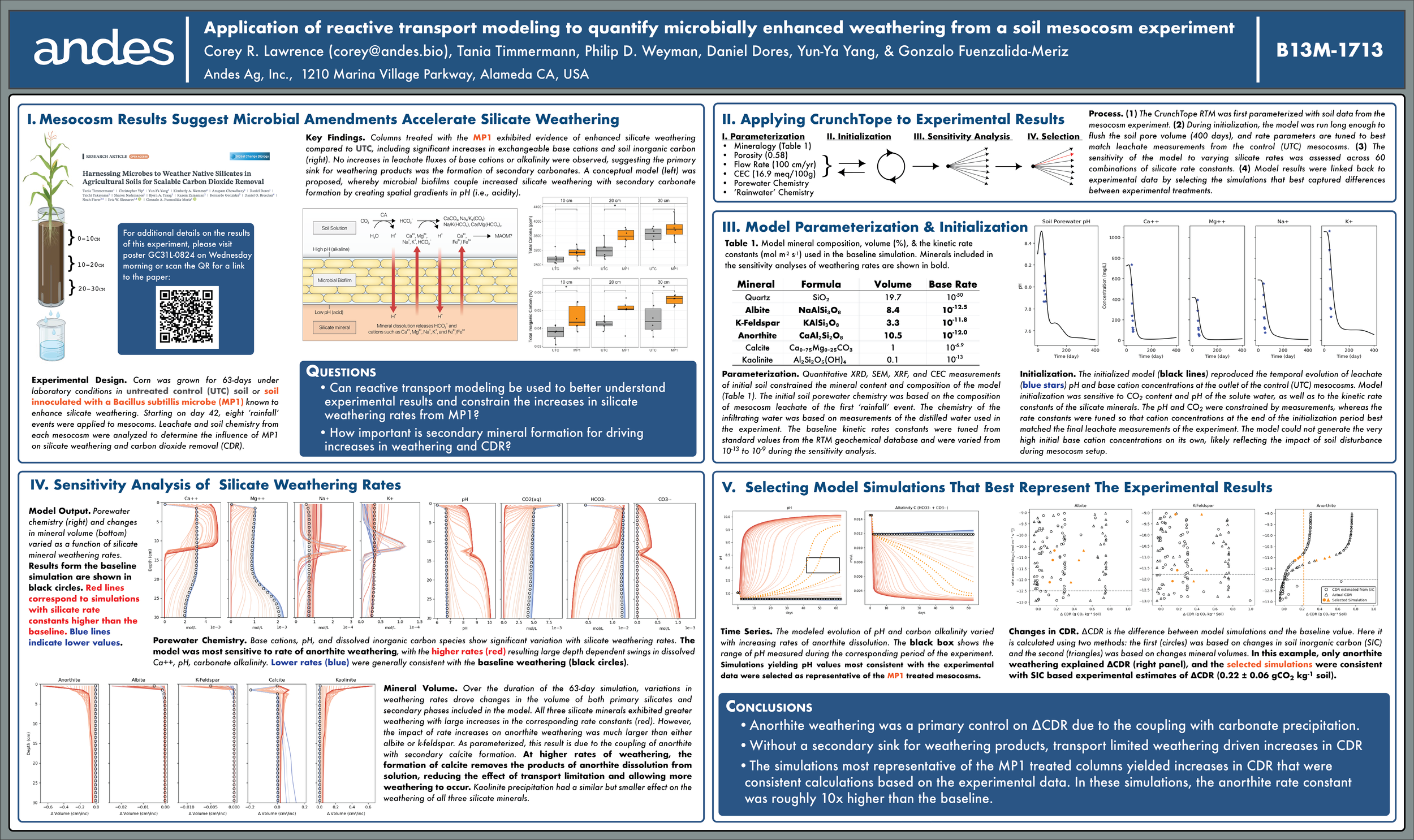
Application of Reactive Transport Modeling to Quantify Microbially Enhanced Weathering from a Soil Mesocosm Experiment
AGU 2025 - New Orleans, LA, USA
To validate and quantify the experimental results from our CDR studies, this research uses the CrunchTope Reactive Transport Model (RTM). By modeling the geochemistry of the soil mesocosms, we constrained the kinetics of the weathering process. The study confirms that the formation of secondary minerals (calcium carbonates) acts as a sink for weathering products, preventing saturation and allowing the weathering process to continue at accelerated rates.
Key Findings:
• Modeling Validation: The reactive transport model successfully reproduced the temporal evolution of leachate pH and cation concentrations observed in the physical experiments.
• Coupled Processes: The model identified that anorthite (a calcium-rich feldspar) weathering coupled with secondary calcite formation is the primary driver of the observed carbon dioxide removal.
• Rate Quantification: Simulations that best matched the experimental data indicated that the anorthite weathering rate constant in MP1-treated soils was roughly 10 times higher than the baseline.
• Carbon Dioxide Removal (CDR): Consistency between model simulations and experimental data confirms that soil inorganic carbon (SIC) measurements provide an adequate and conservative basis for CDR accounting.
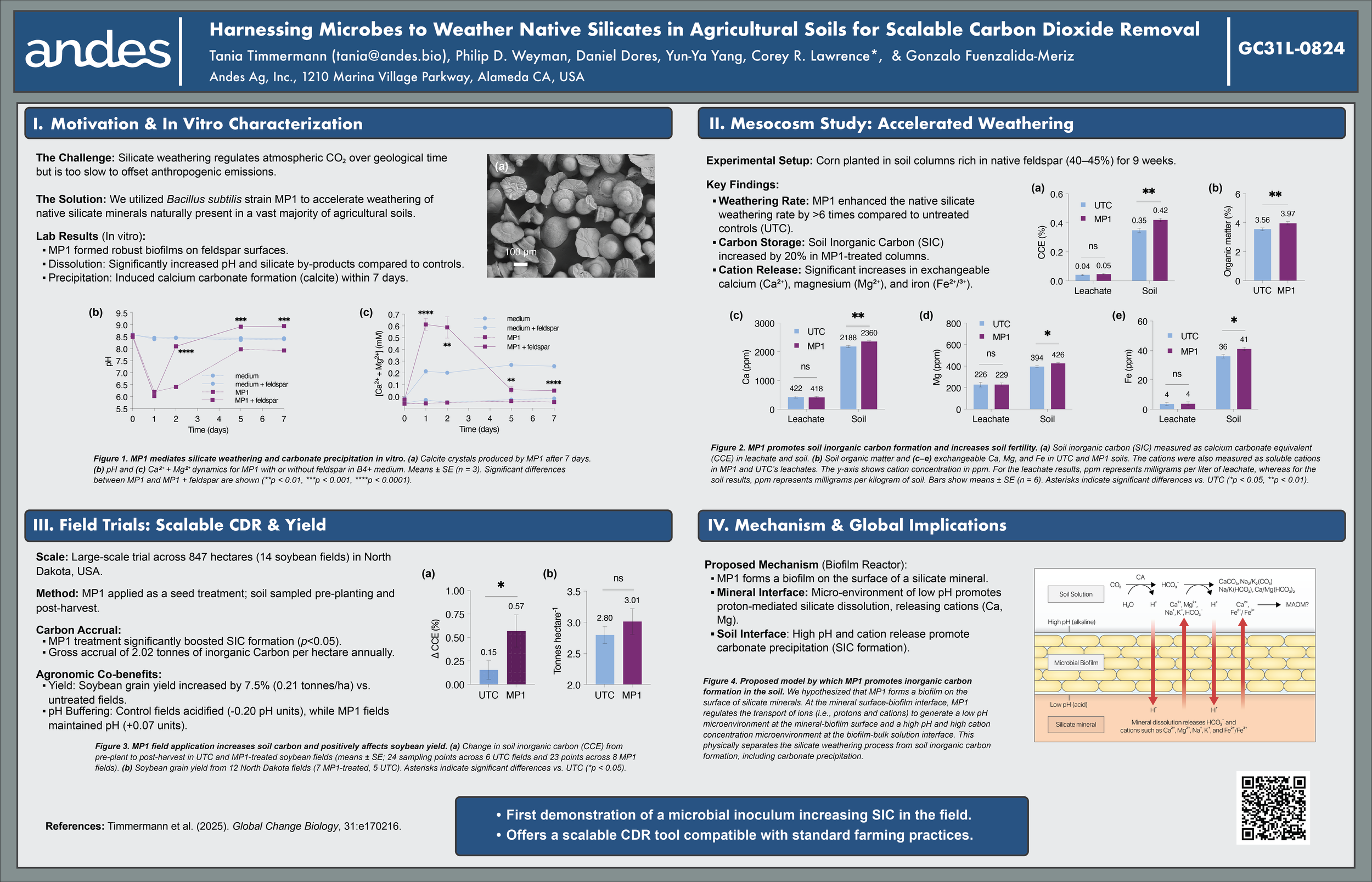
Harnessing Microbes to Weather Native Silicates in Agricultural Soils for Scalable Carbon Dioxide Removal
AGU 2025 - New Orleans, LA, USA
This study provides a comprehensive look at how Andes' beneficial microorganism, Bacillus subtilis strain MP1, accelerates the natural silicate weathering process. The research spans from in vitro laboratory characterization to mesocosm studies and large-scale field trials. The results demonstrate that MP1 forms biofilms on mineral surfaces, creating specific microenvironments that significantly accelerate the release of base cations and the subsequent precipitation of stable carbonates.
Key Findings:
• Mechanism: MP1 forms robust biofilms on feldspar surfaces, generating a low pH microenvironment at the mineral interface for dissolution and a high pH environment at the biofilm surface for carbonate precipitation.
• Accelerated Weathering: In controlled soil columns, MP1 enhanced the native silicate weathering rate by over 6 times compared to untreated controls.
• Carbon Storage: Soil Inorganic Carbon (SIC) increased by 20% in MP1-treated soil columns.
• Field Performance: In a large-scale trial across 847 hectares in North Dakota, USA, MP1 treatment resulted in a gross accrual of 2.02 tonnes of inorganic Carbon per hectare annually.
• Agronomic Benefits: Soybean grain yield increased by 7.5% (0.21 tonnes/ha), and soils showed improved pH buffering compared to controls.
Andes is building a collaborative ecosystem to scale microbial carbon dioxide mineralization globally. Whether you are a researcher, an organization looking to support high-integrity carbon dioxide removal science, or an industry innovator, we want to hear from you. Let’s accelerate the path to scale carbon dioxide removal together.